Quick answer
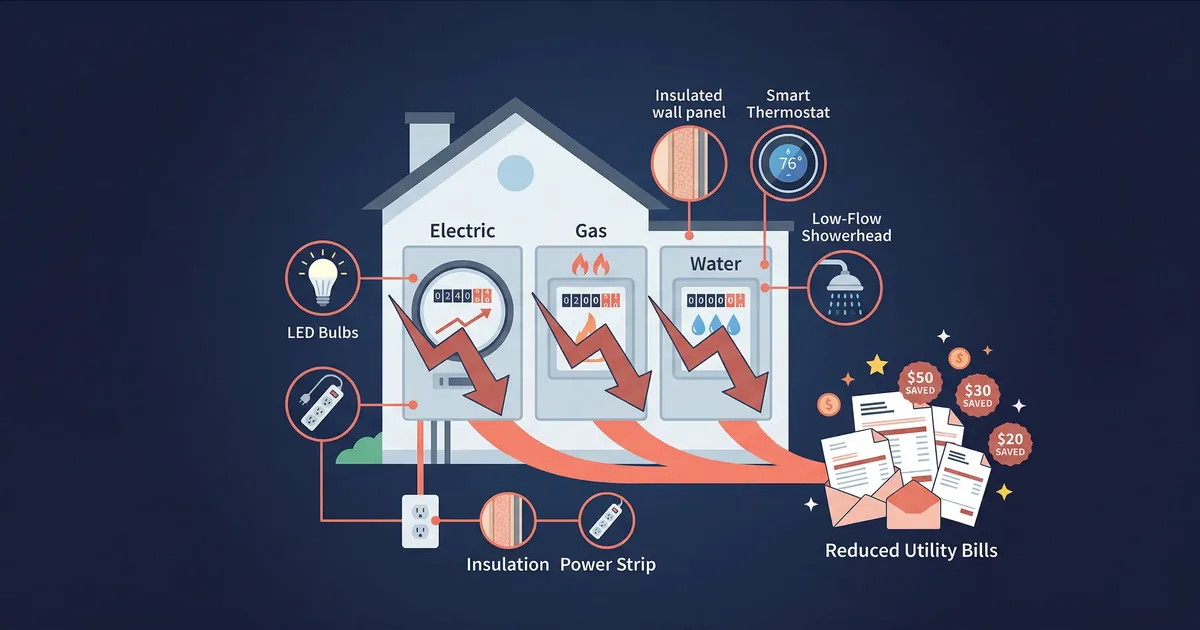
The average American household spends over $2,000/year on utilities. With a few smart changes, you can cut that by 20–40% — that is $400–$800 back in your pocket every year.
The average American household spends over $2,000/year on utilities. With a few smart changes, you can cut that by 20–40% — that is $400–$800 back in your pocket every year.
Electricity Savings
- Switch to LED bulbs: Use 75% less electricity, last 25 years. Replacing 20 bulbs saves $100–$150/year.
- Unplug vampire electronics: Chargers, game consoles, and devices on standby use 5–10% of your electricity. Use smart power strips that cut power automatically.
- Use appliances efficiently: Run dishwasher and washing machine with full loads only. Use cold water for laundry — 90% of washing machine energy goes to heating water.
- Air-dry clothes: Dryers use more energy than any other appliance. Line-drying saves $100–$200/year.
Heating & Cooling (Biggest Impact)
- Install a programmable thermostat: Saves 10–15% on heating/cooling. Set to 68°F when home, 60°F when sleeping, and 55°F when away.
- Seal air leaks: Weatherstrip doors and windows, caulk gaps, and use draft stoppers. Air leaks waste 25–30% of heating/cooling energy.
- Use ceiling fans: Fans cost 1 cent/hour vs. 36 cents/hour for AC. In summer, set counter-clockwise. In winter, clockwise at low speed to push warm air down.
- Change air filters monthly: Dirty filters make your heating and cooling system work 15% harder. A $5 filter saves $15–$20/month in energy.
Water Savings
- Fix leaky faucets: One dripping faucet wastes 3,000 gallons/year. A $2 washer fixes most leaks.
- Install low-flow showerheads: A $15 low-flow head saves 2,700 gallons/year and reduces water heating costs by $70.
- Shorten showers: Cutting showers from 10 to 5 minutes saves 12,500 gallons/year and about $100 in water/heating costs.
Internet & Phone
- Negotiate your bill annually: Call your provider and ask for lower rates. Mention competitor offers. Most companies offer $10–$30/month discounts to keep customers.
Potential Savings Summary
| Strategy | Annual Savings |
|---|---|
| LED bulbs | $100–$150 |
| Unplug electronics | $100–$200 |
| Efficient appliances | $50–$100 |
| Air-dry clothes | $100–$200 |
| Programmable thermostat | $100–$180 |
| Seal air leaks | $100–$200 |
| Ceiling fans | $50–$100 |
| Clean air filters | $60–$120 |
| Fix leaks + low-flow | $70–$150 |
| Shorter showers | $80–$100 |
| Negotiate internet | $120–$360 |
| Total Potential | $930–$1,860/year |
Seasonal Strategy: What Matters Each Quarter
Utility savings compound when matched to the season. The same hour of attention saves $300 in January and $30 in October. Front-load your effort on the quarter where energy use is highest in your climate.
| Season | Highest-impact moves | Typical savings |
|---|---|---|
| Winter (Dec–Feb) | Drop the thermostat 2°F at night; weatherstrip doors and windows; reverse ceiling fans clockwise; insulate the water heater | $80–$150/month |
| Spring (Mar–May) | Schedule HVAC tune-up before peak season; replace air filters; clear AC condenser of leaves; reseal any winter cracks | $30–$60/month preventive |
| Summer (Jun–Aug) | Raise thermostat 2°F during the day; close blinds on south-facing windows; run dishwasher and dryer late evening; switch ceiling fans counter-clockwise | $60–$140/month |
| Fall (Sep–Nov) | Switch to LEDs while utility rebates are open; renegotiate internet contracts before holiday-season hikes; check insulation R-value | $25–$50/month + one-time rebates |
If you only do one thing per season, do these: winter seal leaks, spring service the HVAC, summer shade south-facing windows, fall claim utility rebates.
Five Utility Mistakes That Quietly Cost You $500+ a Year
- Not enrolling in time-of-use rates. If your utility offers off-peak pricing (most do, often opt-in only), running laundry, dishwasher, and EV charging after 9 p.m. can cut electricity costs 20 to 40%. Check your utility's website for a TOU plan and switch.
- Setting the AC fan to "on." Many thermostats default the fan to "on" instead of "auto," meaning the blower runs even when the AC compressor is off. Switching to "auto" alone saves $5 to $15 a month with no comfort tradeoff.
- Heating the water heater above 120°F. Most water heaters ship at 140°F. Drop yours to 120°F — safe, scald-free, and cuts standby loss by 6 to 10% on a major appliance.
- Ignoring federal and utility rebate programs. Most U.S. states pass through Inflation Reduction Act rebates of $200 to $8,000 for heat pumps, insulation, and electrical panel upgrades. Check the database at energy.gov before any big appliance replacement.
- Paying for a top-tier internet plan. A 1 Gbps plan is sold as future-proofing, but most households use under 200 Mbps even with multiple streams running. Test your actual peak usage on speedtest.net for a week and downgrade accordingly — typical savings $20 to $40 a month with no functional difference.
Frequently Asked Questions
What uses the most electricity in a home?
Heating and cooling (50%), water heaters (14%), appliances (13%), lighting (9%), and electronics (14%).
How much can a programmable thermostat save?
10–15% on heating/cooling, or $100–$180 per year for the average household.
Is it cheaper to leave the AC on all day or turn it off?
Raise the temperature 7–10 degrees when away rather than turning completely off. A programmable thermostat automates this.
Do LED bulbs really save money?
Yes. 75% less electricity and 25x longer lifespan. Pays for itself in 2–3 months.
How can I lower my water bill?
Fix leaks, install low-flow showerheads, shorten showers, and run full loads only.