Quick answer
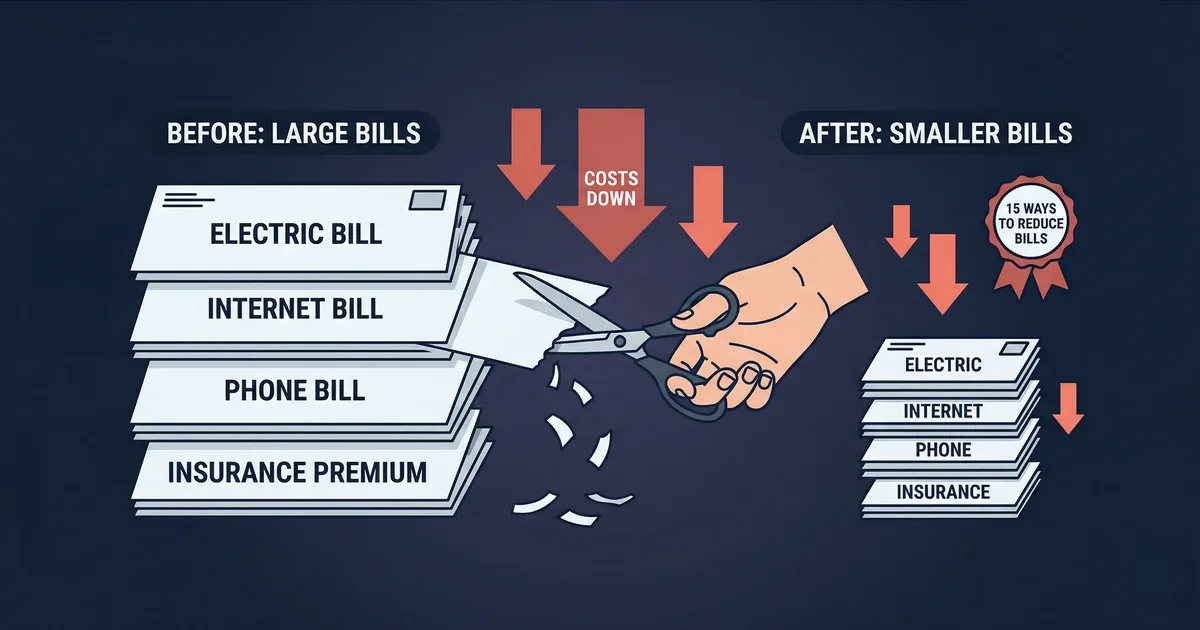
To reduce monthly bills, audit every recurring charge, call retention departments to negotiate internet and insurance, swap to lower-cost alternatives like MVNO phone plans and store brands, and apply for any assistance program you qualify for. The average household frees up $280–$630 per month by working through.
To reduce monthly bills, audit every recurring charge, call retention departments to negotiate internet and insurance, swap to lower-cost alternatives like MVNO phone plans and store brands, and apply for any assistance program you qualify for. The average household frees up $280–$630 per month by working through utilities, telecom, insurance, subscriptions, and food in one weekend.
Not every tactic applies to your house. Pick the three categories where you spend the most and start there. Providers count on you not doing the math. A 15-minute phone call is often worth more per hour than your day job — these are the ways to lower bills real households use.
- Five fastest wins this weekend
- Bill-by-bill savings table
- Lower your utilities
- Cut phone, internet, and cable
- Shop your insurance every renewal
- Audit your subscriptions every 60 days
- Negotiate any bill (with a script)
- Government assistance programs
- Cut banking and credit card fees
- Lower your housing costs
- Trim food and grocery spend
- Build the annual-review habit
- Frequently asked questions
Five fastest wins this weekend
Start here. These five moves typically free up $150–$300 a month — one phone call or app cancellation each.
- Cancel any subscription you have not opened in 30 days. ($15–$80/mo)
- Call your internet retention line and ask for new-customer pricing. ($15–$30/mo)
- Drop your water heater from 140°F to 120°F. (~$36/yr per ten degrees)
- Get three auto insurance quotes at your next renewal. ($300–$700/yr)
- Switch one phone line to an MVNO like Mint or US Mobile. ($30–$55/mo)
Bill-by-bill savings table
The average U.S. household spends roughly $6,440 a month on bills, housing, and food (BLS Consumer Expenditure Survey). Here is what one focused weekend can claw back per year.
| Category | Monthly cost | Top tactic | Yearly savings |
|---|---|---|---|
| Telecom | $180–$300 | Retention call + MVNO swap | $600–$1,500 |
| Utilities | $200–$400 | Thermostat 2°F + LED + power strips | $250–$700 |
| Insurance | $200–$350 | Annual reshop + bundle + raise deductible | $500–$1,200 |
| Subscriptions | $80–$200 | 60-day audit + rotation | $400–$1,200 |
| Housing | $1,200–$2,800 | Renewal negotiation or refi at –0.75% | $600–$3,600 |
| Groceries | $600–$1,000 | Meal plan + store brands + warehouse run | $1,200–$2,400 |
Lower your utilities
Utilities are the slow-leak category. Stack five tweaks and the electric bill quietly drops 15–25%. The full playbook is in our deeper guide to cutting utility bills.
1. Adjust your thermostat
Lower heating 2°F in winter, raise cooling 2°F in summer. Per the U.S. Department of Energy, a sustained 2°F shift trims 3–5% off the annual bill. A $25 programmable thermostat does it for you.
2. Switch to LED bulbs
LEDs use 75% less energy and last 25× longer. Swap the 20 bulbs you actually use; $10–$15 a month disappears.
3. Unplug phantom loads
Energy.gov puts phantom loads — the entertainment center, desktop, kitchen strip — at $150–$200 a year. Switched power strips kill the draw with one toe tap.
4. Run appliances during off-peak hours
If your utility offers time-of-use pricing, run dishwashers and laundry evenings or weekends. Off-peak shifting alone saves 10–20%.
5. Drop your water heater to 120°F
Factory default is often 140°F. Drop to 120°F: ~$36/year per ten degrees, less scald risk, two minutes with a screwdriver. EPA WaterSense backs the 120°F target; a WaterSense showerhead trims 20% off hot-water use.
6. Ask for a free home energy audit
Most utilities offer a free home energy audit that finds air leaks and inefficient appliances. Acting on the recommendations cuts bills 5–30%.
Cut phone, internet, and cable
Telecom is the highest-leverage category. The combined bill runs $180–$300 a month, and ~40% is markup the provider expects you to shrug at.
7. Switch to an MVNO
An MVNO rents space on a major network’s towers. Mint, Visible, and US Mobile run on Verizon or T-Mobile at $15–$40 per line versus $70–$90 at the big three. Move one line first, test a month, move the family.
8. Negotiate your internet bill
Call retention (not regular support), name a competitor promo in your zip code, and ask for new-customer pricing. The average call drops the bill $15–$30 a month in 12–18 minutes. Script below.
9. Cut the cord (or bundle smart)
Swapping cable for one live-TV streaming app plus a couple of on-demand services saves $80–$120 a month. For live sports, price YouTube TV or Hulu Live against your cable triple-play first.
10. Buy your modem instead of renting
Rental averages $15/month ($180/year). A compatible modem is $80–$120 and pays back in seven months. While on the call, ask the rep to automate the autopay discount — most carriers shave $5–$10 per line for autopay plus paperless.
Shop your insurance every renewal
Carriers raise rates on loyal customers in small increments because they assume you won’t notice. One hour of annual quote-shopping is the highest-paying hour of your year.
11. Get three quotes at every renewal
Pull three to five fresh quotes every 12 months, including a regional carrier. The Consumer Reports car insurance guide finds switching every two to three years saves the average driver $300–$700 a year.
12. Bundle auto and home (or renters)
Bundling auto with home or renters at one carrier drops premiums 10–25%. Renters insurance ($12–$20/mo) is often covered by the auto-side discount alone.
13. Raise your deductible wisely
Moving from a $500 to a $1,000 deductible cuts premiums 15–30%. The catch: the gap must be sitting in cash. Park the deductible in your emergency fund first, then call to bump it.
14. Drop collision on older cars
Once a car’s book value drops below ~$3,000, annual collision premiums often equal the max payout. Drop collision, keep liability and comprehensive. Re-quote after credit gains, marriage, or paid-off cars.
Audit your subscriptions every 60 days
The easiest category. The average household pays for 12 subscriptions but uses 4–5. The other seven are pure leak.
15. Pull 60–90 days of statements
Open your statement now. Highlight every recurring charge and cancel anything you opened fewer than four times. Track recurring charges in your budget app so the next audit takes ten minutes.
16. Use a free tool if you won’t do it manually
Rocket Money and Trim surface recurring charges automatically, but their negotiation upsells take 30%–60% of the first year of savings. Use the free audit; skip the upsell.
17. Rotate streaming instead of stacking
Four streaming services at once runs $60+ a month. Rotating one at a time gives you the same library for $15 — one of the cleanest ways to lower bills without giving anything up.
18. Switch to annual billing on the keepers
Apps you will keep all year almost always offer 15–20% off for prepaying annually. Cloud storage, password managers, productivity apps.
Negotiate any bill (with a script you can copy)
Retention reps have discount authority the regular support line doesn’t. The first agent is paid to keep you off the phone; retention is paid to keep you on the books at any reasonable price. A 15-minute call typically frees up $25–$80 per bill per month.
- “Hi — I’ve been a customer since [year] and my account number is [#]. I’m reviewing my bills this month and need to cut some recurring costs.”
- “I see [Competitor] is offering [exact promo] in my zip code. Can you match that or get close?”
- “What current promotions, loyalty credits, or retention offers are available on my account?”
- “Can you remove the modem rental fee or any add-ons I’m not actively using?”
- “If you can’t get me to around $[target], I’d like to be transferred to the cancellation or retention department.”
- “Thanks — can you confirm the new monthly total in writing or by email so I have a record?”
Three rules: be polite, don’t invent competitor offers (reps can verify), and write down the rep’s name and a confirmation number before hanging up. If the bill is genuinely unaffordable rather than inflated, jump to assistance — if even cut bills don’t cover the gap, the income side is the next lever.
Government assistance programs you may qualify for
Assistance programs are not just for the unemployed. Many serve households up to 150–200% of the federal poverty line, which captures a lot of working families. If you assumed you wouldn’t qualify, run the numbers again.
- LIHEAP (Low Income Home Energy Assistance Program): Federal heating/cooling bill help, administered by states. Many cover households up to 150% of the federal poverty line. Apply via your state’s office, the LIHEAP at HHS portal, or by calling 211.
- Lifeline (FCC): Up to $9.25/month off phone or broadband for eligible households. Apply via the FCC Lifeline program or USAC at lifelinesupport.org.
- ACP successor / state low-cost broadband: ACP ended in 2024, but Comcast Internet Essentials, Spectrum Internet Assist, and AT&T Access still offer $10–$30/month plans for SNAP/WIC households. Ask your ISP.
- 211: Dial 2-1-1 from any U.S. phone for a live referral to local utility, water, food, and rent assistance (United Way).
Cross-eligibility is the underused trick: qualifying for SNAP often auto-qualifies you for Lifeline and most ISP low-cost broadband plans. The USA.gov: Help with Energy Bills hub has the current list by program and state.
Cut banking and credit card fees
Bank fees are pure margin you can erase with one or two phone calls.
- Overdraft fees (~$35) are waivable on first request 80%+ of the time. Call and ask politely.
- Monthly maintenance fees (~$15) disappear at no-fee online banks (Ally, SoFi, Discover, Capital One 360).
- Out-of-network ATM fees average $4.77. Pick a bank with a large in-network list or one that reimburses.
- Credit card APR is negotiable. Call every 12 months — if you’ve paid on time, the answer is yes more often than you think.
Then automate transfers to avoid overdrafts in the first place.
Lower your housing costs
Housing is the biggest line item, so even small percentage cuts are the largest dollar wins on this page.
- Renters: Negotiate at renewal with three comparable listings. Offer a 14-month lease for a $50–$100 monthly freeze. Ask to waive valet trash, pet rent, or amenity fees you don’t use.
- Homeowners: Refinance when rates fall ~0.75% below yours AND you plan to stay 24–36 months to recoup closing costs. Drop PMI at 80% LTV via written request. Appeal your property tax assessment if comps sold for less.
Trim food and grocery spend
Food is where budgets quietly bleed; the full grocery savings playbook goes deeper. Three habits do most of the work: weekly meal planning (cuts spend 15–25%, waste 30%), store brands on staples (20–40% cheaper), and swapping four restaurant meals a month for home cooking (saves $100–$200).
Build the annual-review habit
A one-time audit saves money once. A recurring one saves forever. To reduce monthly bills year after year, set a six-month “Bill audit” calendar reminder. Each cycle: pull 60 days of statements, requote insurance, re-check internet promos, cancel one subscription. Pair with a 30-day no-spend challenge to reset spending defaults.
Frequently Asked Questions
How can I lower my bills without giving up things I enjoy?
Start with bills you pay for but barely use — duplicate streaming, an unused gym, your internet’s top tier. A 60-day audit plus one negotiation call frees up $80–$150 a month. Then layer lifestyle-neutral tactics: MVNO, higher deductible, store brands.
What is a subscription audit and how often should I do one?
Pull 60–90 days of statements, list every recurring charge, cancel anything you opened fewer than four times. Do it every two months. Most households find $40–$120 a month in forgotten subscriptions and converted trials.
How much do bill negotiation services like Rocket Money charge?
Rocket Money and Trim take 30%–60% of the first year of any savings they negotiate. A 15-minute DIY call keeps 100% — usually $300–$600 per year per bill.
What's the fastest way to reduce my electric bill?
Drop the thermostat 2°F in winter (or raise 2°F in summer) and unplug devices on switched power strips. Each degree saves ~3% of heating/cooling; phantom loads add up to $150–$200 a year; LEDs add another 5–10%.
Who qualifies for LIHEAP energy assistance?
Most states cover households up to 150% of the federal poverty line; some go to 200%. SNAP, SSI, and TANF recipients are usually auto-eligible. Apply through your state office or by calling 211 — funds run out mid-winter.
Does lowering the thermostat by one degree really save money?
Yes. DOE estimates each 1°F over an 8-hour stretch saves ~1%, and a sustained 2°F shift trims 3–5% off the annual bill. On a $200/month electric bill that is $70–$120 a year.
Can I negotiate my internet bill myself or should I use a service?
Do it yourself. Call retention (not regular support), cite a competitor promo in your zip, ask to remove modem rental and add-ons, and be polite about willing to cancel. The average call drops the bill $15–$30 a month in 12–18 minutes.
What government programs help with utility bills?
LIHEAP (heating/cooling), FCC Lifeline ($9.25/month off phone or broadband), the Weatherization Assistance Program (free insulation), and ISP low-cost plans like Comcast Internet Essentials. Dial 211 for a live referral.
Is it worth refinancing my mortgage to lower my monthly payment in 2026?
Run two numbers: how much the monthly payment drops, and how many months that recoups closing costs (2–4% of the loan). If breakeven is under 36 months and you plan to stay longer, refinancing wins. A 0.75% drop is the rough trigger.
What bills should I cut first?
To reduce monthly bills fastest, cut in this order: subscriptions, phone (MVNO), internet/cable (retention call), insurance (annual reshop). These four moves regularly free up $250–$500 a month in one weekend. Utility tweaks compound but take longer to show.