Quick answer
The pay yourself first method is a savings system where you transfer a fixed percentage of every paycheck — typically 10 to 20 percent — into savings, retirement and investment accounts before paying any bill or buying anything. Coined in George S. Clason’s 1926 book The Richest Man in Babylon , it removes willpower.
The pay yourself first method is a savings system where you transfer a fixed percentage of every paycheck — typically 10 to 20 percent — into savings, retirement and investment accounts before paying any bill or buying anything. Coined in George S. Clason’s 1926 book The Richest Man in Babylon, it removes willpower from saving by making it the first transaction, not the last.
If you want a private, offline place to track those automated transfers, Budget Lock is built for it.
- What the method actually means
- Where it came from (the 1926 origin)
- Why it works (with the data)
- Pay yourself first vs 50/30/20 vs zero-based vs envelope
- What percentage should you pay yourself?
- The 4-step setup
- Three worked examples ($40K, $75K, $120K)
- Where to actually park the money
- When pay yourself first is the wrong call
- Frequently asked questions
What the pay yourself first method actually means
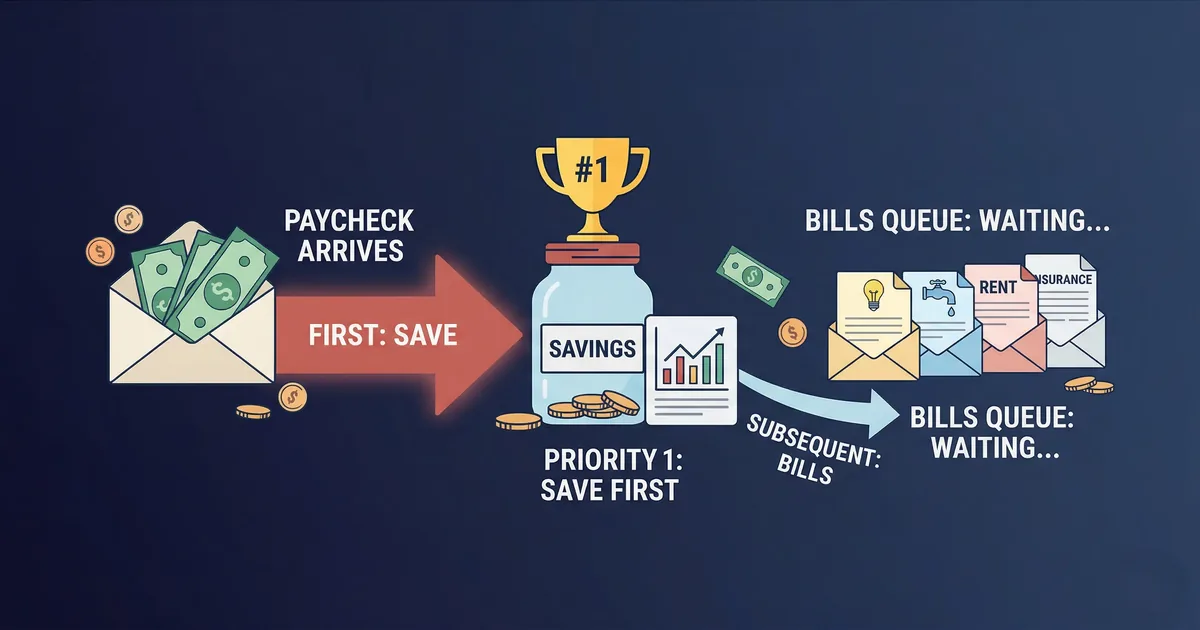
Most budgets pay bills first and save what is left. The pay yourself first method does the opposite: the moment your paycheck lands, a fixed slice moves to savings, retirement and investment accounts before rent, groceries or the streaming bill. You build a spending plan from what remains.
You will see the same idea sold as “reverse budgeting.” The mechanics are identical — savings come off the top and the rest of the budget reshapes around the smaller number. Investopedia’s pay-yourself-first entry uses the two terms interchangeably.
Pay yourself first: Income → Savings → Bills → Spending (what’s left)
Where the method came from (the 1926 origin)
The phrase traces back to George S. Clason’s The Richest Man in Babylon, bound into a book in 1926. The narrator, a Babylonian merchant named Arkad, explains how he became wealthy with one rule: “For every ten coins I placed within my purse, for spending I took out but nine.” That ninth-coin discipline — the “one-tenth rule” — is the original 10% pay yourself first.
A century later, the same idea is baked into U.S. retirement infrastructure: auto-enrolled 401(k) plans take a slice of every paycheck before it lands in checking, which is Arkad’s rule applied at industrial scale. You can read the parable free on the original 1926 text at Project Gutenberg Australia.
Why it works (with the data)
The case for paying yourself first is structural, not motivational. When you automate the transfer on payday, the money moves whether you feel disciplined that week or not. The SECURE 2.0 Act, signed in late 2022, now requires most new 401(k) and 403(b) plans to auto-enroll employees at 3% of pay with annual one-point step-ups to at least 10%.
That default flip matters. Vanguard’s plan-data summaries put participation under auto-enrollment at roughly 93%, against about 28% for new hires who must opt in. Same workers, same incomes — the only difference is whose default it is. Pay yourself first also prevents lifestyle creep, because raises pad the savings bucket before the spending bucket sees them, and it exploits loss aversion: money you never had in checking does not feel like money you lost. Richard Thaler and Shlomo Benartzi’s “Save More Tomorrow” program built an entire 401(k) design around exactly this insight.
Pay yourself first vs 50/30/20 vs zero-based vs envelope
People treat budgeting methods as rivals. They are not. Pay yourself first is an order-of-operations rule; the 50/30/20 rule, zero-based budgeting and envelope budgeting are allocation frameworks. You can run pay yourself first underneath any of them.
The cleanest combination is pay yourself first stacked on top of 50/30/20: you automate the 20% savings transfer the second your paycheck lands, then divide the remaining 80% between needs and wants. The table below shows how the four methods slot together.
| Method | What it controls | Effort level | Best for | Plays well with PYF? |
|---|---|---|---|---|
| Pay yourself first | The savings transfer | Set once, then auto | Habit-builders, automation lovers | n/a — this is it |
| 50/30/20 | Full % allocation (needs / wants / savings) | Low | Beginners who want a simple frame | Yes — PYF runs the 20% bucket |
| Zero-based | Every dollar by category | High | High-control, debt-payoff, irregular income | Yes — assign the savings line first |
| Envelope (cash or digital) | Spending by category | Medium | Overspenders in one or two categories | Yes — layer envelopes on the 80% |
What percentage should you pay yourself?
The right number depends on your debt, your emergency cushion and how steady your income is. Three benchmarks anchor the conversation: 10% is Clason’s historical floor, 15% is the Fidelity-style retirement-savings benchmark, and 20% is the savings slice of 50/30/20 (also marketed as the “80/20 budget rule”).
| Tier | Of net pay | Best when | Trade-off |
|---|---|---|---|
| 10% | $10 of every $100 | You are starting out, paying down debt above 15% APR, or carry an irregular income | May fall short of long-term retirement targets on its own |
| 15% | $15 of every $100 | You have a small emergency fund, no high-interest debt, and a stable paycheck | The Fidelity benchmark for hitting retirement goals — and it stings the budget at first |
| 20% | $20 of every $100 | You have 3+ months of expenses saved and a clear long-term goal | Hard to sustain on a tight single income or with kids |
One nuance: the 50/30/20 and 80/20 splits are calculated on net (take-home) pay, while the 15% retirement benchmark is calculated on gross. If you save 15% of net thinking you are hitting the retirement target, you are actually undershooting by roughly 20 to 25 percent depending on your tax bracket. Pick a base — net or gross — and stay consistent so the math doesn’t lie to you.
The 4-step setup (10 minutes, once)
-
Step 1: Pick the percentage and the goal
Use the table above to choose a percentage you can sustain for at least twelve months. Then sequence the goals: a $1,000 starter buffer first, then enough 401(k) contributions to capture the full employer match, then any debt above ~15% APR, then a 3 to 6 month emergency fund, then a Roth IRA, then long-term investing. The order matters more than the speed.
-
Step 2: Open accounts at a different bank
Friction is your friend. Keep savings at a different bank from your checking so a transfer takes a few business days — long enough to defuse most impulse buys. Top picks for May 2026: Ally Bank (up to 30 buckets), Marcus by Goldman Sachs (no minimums), SoFi (20 Vaults plus a competitive APY), Discover Online Savings, and Wealthfront Cash.
-
Step 3: Schedule the transfer for payday
The highest-leverage move is splitting your direct deposit at the source. Most U.S. payroll systems — ADP, Gusto, Workday, Paychex — let you route a fixed dollar amount or percentage to a second account on every pay run, so the money never touches checking. If your employer doesn’t support a split, schedule a recurring bank transfer for the same day the paycheck lands.
-
Step 4: Re-budget the remainder
Only now do you build a monthly budget — from what is left after savings are removed. This is the “reverse” in reverse budgeting: the spending plan is downstream of the savings transfer, not the other way round. Park short-term goals like a vacation or a car repair in named sinking funds so they don’t fight the emergency fund for space.
Three worked examples — $40K, $75K, $120K take-home
Numbers below use conservative blended returns (5% for beginner/intermediate, 7% for advanced) and ignore taxes, employer match and inflation. Illustrative, not projections.
| Bucket | Monthly | Per year | After 5 years (5% blended return) |
|---|---|---|---|
| HYSA emergency fund | $165 | $1,980 | ~$11,200 |
| Roth IRA | $100 | $1,200 | ~$6,800 |
| Total to self | $265 | $3,180 | ~$18,000 |
| Bucket | Monthly | Per year | After 5 years (5% blended return) |
|---|---|---|---|
| HYSA emergency fund | $200 | $2,400 | ~$13,600 |
| 401(k) (with 401(k) match) | $300 | $3,600 | ~$20,400 |
| Roth IRA | $200 | $2,400 | ~$13,600 |
| Total to self | $700 | $8,400 | ~$47,600 |
| Bucket | Monthly | Per year | After 5 years (7% blended return) |
|---|---|---|---|
| HYSA emergency fund | $200 | $2,400 | ~$13,800 |
| 401(k) (max-friendly) | $700 | $8,400 | ~$48,300 |
| Roth IRA | $300 | $3,600 | ~$20,700 |
| Brokerage / sinking funds | $200 | $2,400 | ~$13,800 |
| Total to self | $1,400 | $16,800 | ~$96,600 |
The advanced tier brushes against the IRS contribution ceilings. For 2026, the 401(k) employee deferral limit is $24,500 and the IRA limit is $7,500 — check the current numbers on the IRS 401(k) contribution limits page before maxing anything out.
Where to actually park the money (HYSA + IRA picks for May 2026)
The account matters almost as much as the percentage. Top high-yield savings accounts are paying around 4.20% APY in May 2026 against an FDIC national savings average of about 0.38% — roughly $400 a year on a $10,000 balance for the work of opening one account.
HYSA picks: Ally Bank, Marcus by Goldman Sachs, SoFi, Discover Online Savings, and Wealthfront Cash, which sweeps deposits across a network of partner banks so coverage can exceed the standard limit — check the current figure with the provider before you rely on it. For retirement, capture the workplace 401(k) match first — a guaranteed 50 to 100 percent return on the first dollars — then open a Roth IRA at Fidelity, Charles Schwab or Vanguard. All three have $0 minimums and free index funds.
- $1,000 starter buffer in a HYSA
- Full employer 401(k) match (free money)
- Pay off any debt above ~15% APR
- 3–6 month emergency fund in HYSA, then fill the IRA
- Top up the HYSA / brokerage / sinking funds for specific goals
One final note on safety: every HYSA above pays its APY only inside FDIC deposit insurance limits ($250,000 per depositor, per insured bank, per ownership category). Spread balances across institutions if you cross the line.
When pay yourself first is the wrong call
The method has two failure modes. The first is using it to ignore expensive debt: if you carry credit-card balances above ~15% APR, every dollar saved at 4% in a HYSA loses 11 cents to interest in the background. Build a $1,000 cushion, then redirect everything else to the avalanche payoff until the high-interest balance is gone.
The second is rigid dollar amounts on irregular income. If you bring in $6,000 one month and $2,500 the next, a fixed $1,000 transfer wipes out the lean month — save a fixed percentage of every deposit instead, and route windfall months to a buffer account.
- Carrying 20%+ APR debt: $1,000 buffer first, then debt avalanche, then resume.
- Income that swings month to month: save a percentage, never a fixed dollar amount.
- No emergency fund and a fragile budget: start at 1–5% so an unexpected bill doesn’t force the transfer back — reversing the transfer kills the habit faster than missing a single payday.
Track Your Pay-Yourself-First Method
Budget Lock helps you set savings goals, track progress, and manage spending — all offline, free forever, with AES-256 encryption.
Download Budget Lock — FreeFrequently Asked Questions
What is the pay yourself first method?
The pay yourself first method is a savings system where you transfer a fixed percentage of every paycheck — usually 10 to 20 percent — into savings, retirement and investment accounts before paying any bill or making any purchase. The phrase comes from Clason’s 1926 book The Richest Man in Babylon, and it works because it makes saving the default rather than a willpower decision.
What percentage should I pay myself first?
The standard recommendation is 10 to 20 percent of income. Ten percent is the historical floor from Clason’s “one-tenth” rule, fifteen percent is the Fidelity-style retirement benchmark, and twenty percent matches the savings slice of the 50/30/20 rule. Pick the highest number you can sustain for twelve months, then raise it by one point after every raise.
Is the pay yourself first method the same as reverse budgeting?
Yes. Reverse budgeting is just the modern label — both flip the usual order so savings come off the top and your spending budget gets built from what remains. You will see the two terms used interchangeably by NerdWallet, Prudential and most major banks.
Pay yourself first vs the 50/30/20 rule — which is better?
They are not in competition. The 50/30/20 rule is a full allocation framework (50% needs, 30% wants, 20% savings). Pay yourself first is the order of operations that runs the 20% bucket. Most households use both: automate the 20% transfer first, then divide the remaining 80% between needs and wants.
Should I pay myself first while I am in debt?
Save a small $500 to $1,000 cushion first so the next surprise expense doesn’t land on a credit card, then redirect the rest of the savings line to the debt while the balance carries above roughly 15% APR. Once the high-interest debt is clear, raise the savings percentage back up.
How do I pay myself first with irregular income?
Save a fixed percentage of every deposit instead of a fixed dollar amount. If you bring in $6,000 one month and $2,500 the next, transferring 20% sends $1,200 and $500 respectively — the math always works. Route windfall months entirely to a buffer account that smooths out the lean months.
Where should the money I pay myself actually go?
Sequence usually runs: a $1,000 starter buffer, then the employer 401(k) match (free money), then high-interest debt, then a 3 to 6 month emergency fund in a high-yield savings account, then a Roth IRA, then long-term investing or specific goals like a house or vacation. This order maximises return per dollar.
What is the best account for paying myself first?
A high-yield savings account at a different bank from your checking — friction matters. As of May 2026, top HYSAs pay around 4.20% APY (Ally, Marcus, SoFi, Discover, Wealthfront Cash) versus the FDIC average of about 0.38%. For retirement, the 401(k) match comes first, then a Roth IRA at Fidelity, Schwab or Vanguard.
Can I pay myself first on a low income?
Yes. Even $10 to $25 per paycheck builds the muscle memory, and the percentage matters more than the dollar amount in the first year. Once you get a raise or finish paying off a bill, redirect that exact amount to savings before lifestyle creep absorbs it. The habit compounds long before the money does.
Does paying yourself first count toward retirement contributions?
Absolutely — 401(k), IRA and HSA contributions are the purest form of paying yourself first because the money is removed from your paycheck before it ever hits your checking account. Auto-enrolled 401(k) plans, now standard under the SECURE 2.0 Act, push participation to roughly 93% versus 28% for opt-in plans.