Quick answer
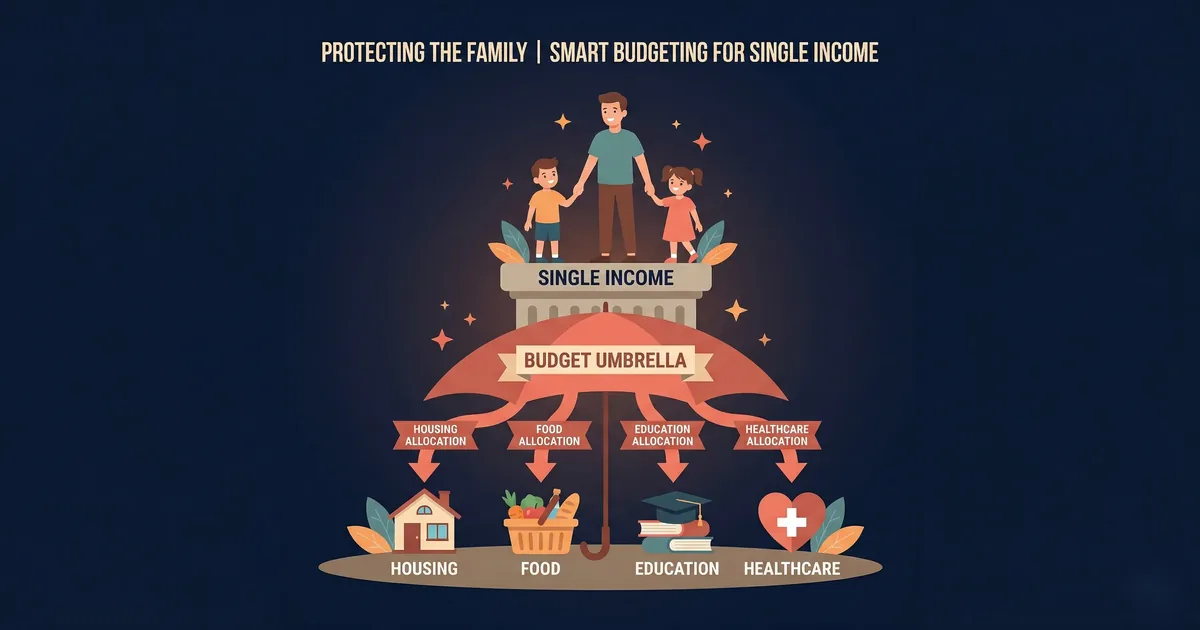
Can a family live on one income? Yes — most families that pull it off keep total housing under 25% of take-home pay, run a zero-based budget on the working spouse’s paycheck, hold a six-to-nine-month emergency fund, and align every bill due date to land within seven days of payday.
Can a family live on one income? Yes — most families that pull it off keep total housing under 25% of take-home pay, run a zero-based budget on the working spouse’s paycheck, hold a six-to-nine-month emergency fund, and align every bill due date to land within seven days of payday.
This is the working family budget for single-income households we wish someone had handed us before we tried it: sample numbers for families of three, four, and five, the childcare-versus-stay-home math, the government programs you may now qualify for, and a 12-month dress rehearsal. Budget Lock runs the zero-based budget below offline, no subscription — see the Play Store listing.
- The single-income reality in 2026
- A 60/20/20 split works better than 50/30/20
- Sample budgets — families of 3, 4, and 5
- Cost-cutting that moves the needle
- The childcare-versus-stay-home math
- Healthcare and government programs
- Run a 12-month dress rehearsal
- Align every bill to one paycheck
- Insure the income, protect the credit
- Earning from home without taking over the kitchen
- Frequently asked questions
The single-income reality in 2026
One income is normal. Roughly one in three U.S. families with children already live on a single paycheck, whether by choice, layoff, caregiving need, or chronic illness. The math is tighter, not impossible — the same monthly-budget steps you would use on two paychecks still work, they just leave less margin. If you want a refresher on the mechanics, our monthly budget walkthrough covers the basics.
For context: the average U.S. household spends about $77,280 a year, with housing at roughly 33%, transportation at 17%, and food at 13% of expenditures, per the BLS Consumer Expenditure Survey. The USDA estimate for raising one middle-income child to age 17 lands between $233,000 and $290,000 in current dollars.
Three structural risks shape every one-income decision: no income redundancy (job loss takes out 100%, not 50%), an emergency fund target that moves from 3–6 months up to 6–9, and life plus long-term disability insurance becoming load-bearing rather than optional. The rest of this guide is built around those three facts.
A 60/20/20 split works better than 50/30/20 on one income
The classic 50/30/20 rule assumes a household where two paychecks share the load on housing, healthcare, and childcare. On one paycheck, the “needs” bucket runs hotter because every essential is paid by one stream. Most one-income families with kids land closer to 60% needs / 20% wants / 20% savings and debt — and that is the realistic starting point, not a failure.
On a $5,000 take-home month, that looks like $3,000 toward housing, utilities, food, transportation, healthcare, and insurance; $1,000 toward wants and lifestyle; and $1,000 toward savings, retirement, and debt payoff. If needs spill past 65%, pull the lever on housing or transportation — not the savings rate. Pair the split with zero-based budgeting so every dollar gets a job before the month starts; there is no second check on the 22nd to absorb mistakes.
Sample one-income family budgets — families of 3, 4, and 5
Three concrete one-income family budgets at common income tiers, built around BLS expenditure shares and USDA Low-Cost Food Plan figures. Costs vary widely by metro — the EPI Family Budget Calculator is the best tool to translate these into your county.
| Category | Family of 3 ($50K) | Family of 4 ($75K) | Family of 5 ($100K) |
|---|---|---|---|
| Take-home pay | $3,400 | $5,000 | $6,500 |
| Housing (rent/mortgage, taxes, insurance) | $950 | $1,250 | $1,625 |
| Groceries | $525 | $750 | $975 |
| Utilities & internet | $240 | $325 | $425 |
| Transportation (one car) | $340 | $500 | $650 |
| Healthcare premiums & out-of-pocket | $275 | $400 | $520 |
| Term life & disability insurance | $120 | $175 | $225 |
| Debt payments (above minimums) | $135 | $200 | $260 |
| Savings, retirement & sinking funds | $510 | $750 | $975 |
| Kids — clothes, school, activities | $170 | $250 | $400 |
| Personal, household & fun | $135 | $400 | $445 |
| Total | $3,400 | $5,000 | $6,500 |
Reading one row: groceries for the family of four at $750 is roughly the midpoint of the USDA Low-Cost Food Plan in 2026 dollars. The savings line funds the emergency target, retirement (including a spousal IRA), and a sinking fund or two. The transportation line assumes one car; if you need two, it shifts $200–$300 from wants or savings.
Cost-cutting that moves the needle on one paycheck
Skip the “skip your latte” advice. On one income, the four levers below move enough money to matter, ranked by dollar impact.
Housing — the $400 to $800 per month lever
This is the single biggest line item and the only one large enough to fix a broken budget by itself. Keep PITI plus HOA at or below 25% of take-home. If your mortgage rate is more than 1.5 points above current rates, run a refinance break-even (closing costs divided by monthly savings); a 24-month break-even is usually worth doing. If you are considering downsizing, do it while both paychecks still qualify you for the new loan — not after the transition, when underwriting only sees one income.
Groceries — $200 to $400 per month
Treat the USDA Low-Cost Food Plan as a target, not a floor. The mechanics that actually work: pick five to seven anchor meals built around sale-cycle proteins (chicken thighs, ground beef, eggs, beans, frozen fish), then rotate sides. Cap restaurants at one planned outing per week with a sinking fund of $80–$120 per month so “treat night” is not a budget event. Our guides on cutting the grocery bill and meal-planning around five to seven anchor meals have the playbook in detail.
Transportation — about $8,100 per car per year
BLS pegs the average annual cost of car ownership above $8,000 once you include payment, insurance, gas, registration, and maintenance. If commute and school logistics allow, dropping to one car frees the largest chunk of money outside housing. If you can’t, the second car should be a paid-off used vehicle you keep for ten-plus years — not a $450/month payment on a newer model.
Insurance and recurring bills
Re-shop home, auto, and term life every 12–18 months — loyalty is not rewarded. Annually, renegotiate cell, internet, and streaming; a 20-minute call typically saves $30–$80 a month. Audit subscriptions quarterly.
The childcare-versus-stay-home math
This is the decision behind most one-income transitions and the one that gets argued about most. Here is the actual math, no judgment in either direction. Center-based infant care now exceeds $1,500 per month per child in most metros, and according to the Economic Policy Institute, childcare costs more than in-state public college tuition in 38 states plus DC.
$20/hour × 20 hours/week × 4.3 weeks = $1,720 gross per month.
After taxes, payroll deductions, and FICA: roughly $1,300 net.
Minus part-time daycare ($1,000), commute and parking ($120), work clothes and lunches ($60): ~$120 true monthly contribution.
And that is before counting the after-tax loss of EITC and Child Tax Credit phase-ins that often kick in when household income crosses certain thresholds.
With two kids under five, the second income often nets $0–$700/month after childcare and work costs — sometimes negative. With one school-age child, the second income usually clears more than after-school care, so the math flips. Anyone making this call is under more pressure than the spreadsheet shows; the spreadsheet is one input, not the verdict. Our guide on budgeting around a new baby covers the rest.
Healthcare and government programs you may now qualify for
Dropping to one income often crosses household-income thresholds that unlock real money. These are tax credits and benefit programs your household paid into — using them is not charity, and leaving them on the table is one of the costliest mistakes one-income families make.
- ACA marketplace premium tax credits: caps marketplace premiums at 8.5% of household income; a family of 4 at $80K can see premiums drop by hundreds of dollars per month. Run the estimator at Healthcare.gov.
- SNAP (food assistance): gross-income limit is roughly $3,380/month for a family of 4 in 2026. Eligibility details at USDA FNS.
- WIC: for pregnant women, infants, and kids under 5; gross-income limit roughly $4,810/month for a family of 4.
- CHIP and Medicaid for kids: income limits are higher than for adults; many one-income families qualify for the kids even when the parents do not.
- Child Tax Credit: up to $2,000 per qualifying child under 17.
- Earned Income Tax Credit: a refundable credit for working families — one income often qualifies more than two did.
- Dependent Care FSA: if any childcare cost remains, $5,000/year of pre-tax money for it.
- Spousal IRA: the working spouse can contribute up to $7,000 (2026) into a traditional or Roth IRA opened in the non-working spouse’s name. Automate the spousal IRA transfers on payday so it happens before the money is spent.
Run a 12-month one-income dress rehearsal
If you are still on two incomes and planning the transition, do not just “cut and see what happens.” A 12-month dress rehearsal — banking 100% of the leaving spouse’s checks for six months pre-transition — both pre-funds the emergency fund and surfaces the real budget gap before it hurts.
- Months 1–3 — Track and measure. Track every dollar on the current two-income setup. Calculate the staying spouse’s true take-home (after taxes, retirement, healthcare). That number is your new ceiling.
- Months 4–6 — Restructure. Shift bill due dates to land 1–7 days after payday (see the next section). Refinance, downsize, or trade down a car while both incomes still qualify you on paper.
- Months 7–9 — Live the budget. Live entirely on the staying spouse’s paycheck. Bank 100% of the other check. Things will break — that is the point. Fix them now while there is a safety net.
- Months 10–12 — Lock it in. Top up the emergency fund to six-to-nine months of essential expenses. Lock in 20-to-30-year level term life and long-term disability while the leaving spouse still has employer coverage and a fresh medical exam.
Align every bill to one paycheck
With two incomes, late-month bills get absorbed by the second check. With one, due dates that fall mid-month between paychecks crater cash flow and make you look broke when you are not.
Most utilities, lenders, and credit cards will move your due date for free if you call. The script: “I’d like to change my due date so it falls within five days of the 1st (or the 15th).”
One 20-minute phone session moving four or five bills can rebuild your cash flow more than any spending cut.
Insure the income, protect the at-home parent’s credit
First: insure the income. The floor recommendation for term life on the working spouse is 10× gross salary, level term, 20- or 30-year. Long-term disability matters even more — you are statistically far more likely to be disabled than to die during working years. Group LTD through the employer is the cheapest entry point; buy it the day you become eligible. Treat the annual term-life premium as a sinking fund and the renewal month never surprises you.
Second: protect the at-home spouse’s credit. After seven-plus years out of payroll, credit history quietly slides off the grid — a problem the day they need to refinance, lease, or get a credit line in their own name. Two moves cover most of it: add the at-home spouse as an authorized user on the working spouse’s longest-held card, and open one small card in their own name with auto-pay on a single recurring bill (cell phone or streaming). Pay in full, every month.
Earning from home without it taking over the kitchen
Realistic numbers: median side income for stay-at-home parents lands around $400/month — enough to close most one-income budget gaps without becoming a second job. Service-based work (virtual assistant, bookkeeping, freelance writing) reaches $1,500–$2,500/month at three to six recurring clients, the upper realistic band.
| Side income | Realistic monthly range | Schedule flexibility |
|---|---|---|
| Freelance writing or design | $500–$2,000 | High |
| Online tutoring | $300–$1,000 | High |
| Virtual assistant or bookkeeping | $500–$2,500 | Medium |
| Selling crafts or print-on-demand | $200–$800 | Medium |
| In-home childcare for one extra child | $400–$1,200 | Low |
Frequently Asked Questions
Can a family live on one income in 2026?
Yes, and roughly 1 in 3 U.S. families with children already do. The math holds when you keep total housing under 25% of take-home pay, run a zero-based budget on the working paycheck, carry a six-to-nine-month emergency fund, and align every bill due date within seven days of payday.
What is a good budget for a family of four on one income?
On a $5,000/month take-home, a workable split is housing $1,250, groceries $750, utilities $325, transportation $500, healthcare $400, insurance $175, debt $200, savings and retirement $750, kids and activities $250, and personal $400. Adjust upward in high-cost-of-living metros and downward in lower-cost states.
How big should our emergency fund be on one income?
Six to nine months of essential expenses, not the standard three to six. There is no second paycheck to bridge a job loss, illness, or pay cut. Build a $1,000 starter cushion fast, then stair-step to one full month of expenses, then six, then nine. Park it in a high-yield savings account, not your checking.
Should we use the 50/30/20 rule on one income?
It is a starting point, but most one-income families with kids land closer to 60/20/20 because childcare-free households still pay full freight on food, healthcare, and housing per person. Run the strict 50/30/20 first; if needs spill past 65%, the lever to pull is housing or transportation, not the savings rate.
Do we qualify for ACA subsidies after dropping to one income?
Often yes. Premium tax credits cap marketplace premiums at 8.5% of household income with no 400%-of-FPL income cliff. A family of four earning $80K can see premiums drop by several hundred dollars per month. Run the estimator at Healthcare.gov before assuming COBRA is your only option.
Can a stay-at-home parent contribute to a retirement account?
Yes, through a spousal IRA. The working spouse can contribute up to $7,000 (2026 limit, or $8,000 if the at-home spouse is 50+) into a traditional or Roth IRA opened in the non-working spouse’s name. The household just needs enough earned income to cover the contribution. It is the simplest retirement-equity move for one-income families.
Does a stay-at-home parent really save money versus paying for childcare?
For two or more kids under five, almost always yes — center-based infant care exceeds $1,500/month per child in most metros, and that is before commute, work clothes, takeout, and the after-tax loss of EITC and CTC phase-ins. With one school-age child, the second income often clears more than the cost of after-school care, so the math flips.
How long should we run a one-income trial before quitting the second job?
Three to six months at minimum, and ideally part of a 12-month plan. Live entirely on the staying spouse’s paycheck and bank 100% of the other check. The bank balance becomes the emergency fund, and you find out which budget categories are actually broken before they have real consequences.
How does the at-home parent build or protect their credit?
Two moves cover most of it. Get added as an authorized user on the working spouse’s longest-held credit card so the account history reports on the at-home spouse’s credit file. Open one small card in the at-home spouse’s name and auto-pay a single recurring bill (cell phone, streaming) to keep it active without temptation.
What government benefits should a one-income family check eligibility for?
The list worth running through: ACA marketplace premium tax credits, SNAP (gross-income limit ~$3,380/month for a family of four in 2026), WIC for kids under five (~$4,810/month limit), CHIP or Medicaid for the kids, the Earned Income Tax Credit, the Child Tax Credit, and a Dependent Care FSA if any childcare cost remains.